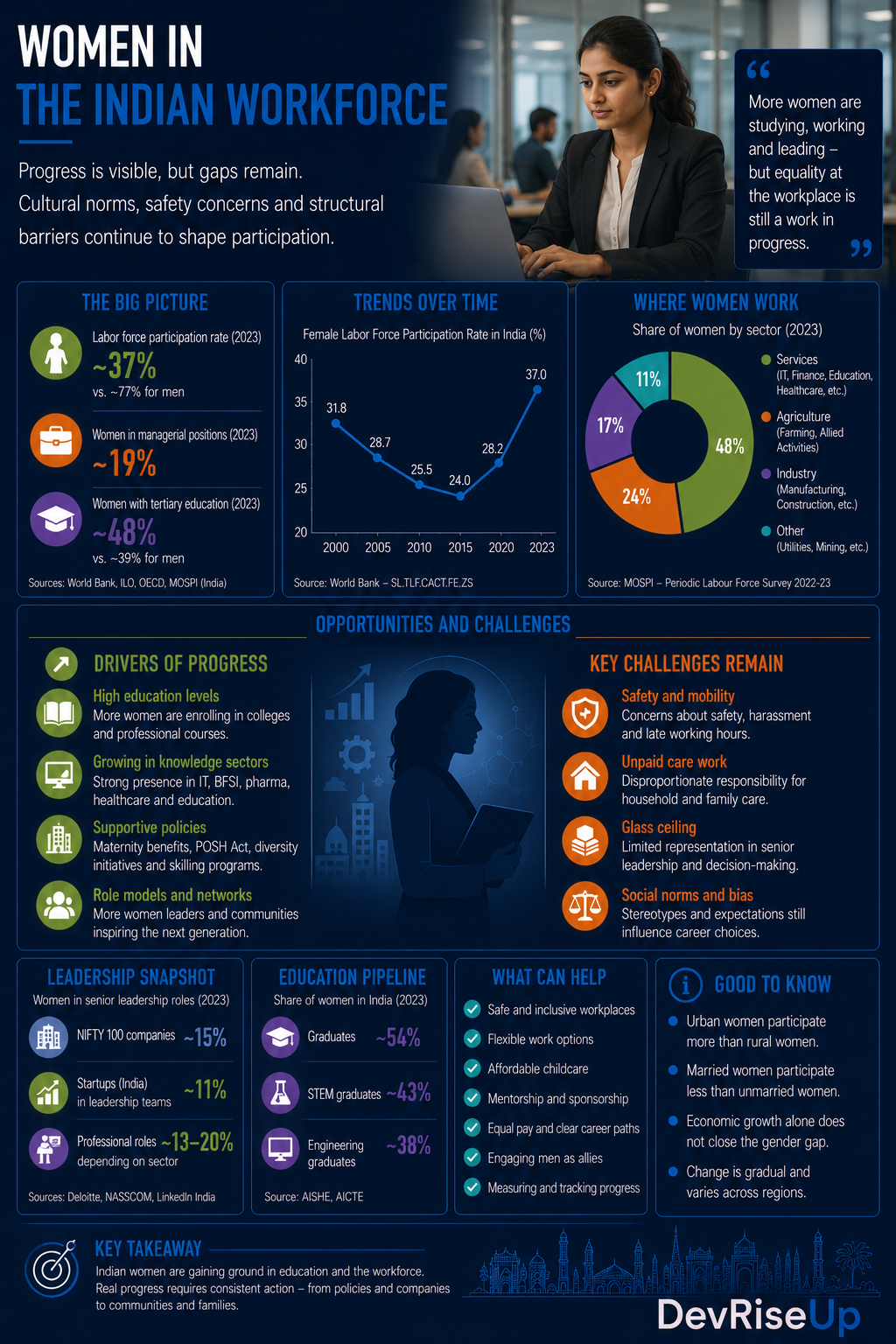
India has produced some of the best-known female business leaders in the world. Indra Nooyi led PepsiCo. Kiran Mazumdar-Shaw built Biocon into a global pharmaceutical company. Nita Ambani shapes the cultural life of Mumbai. These names are real, and they are not representative.
Behind these success stories lies one of the lowest female labor force participation rates in the world.
The Numbers
According to data from the Centre for Monitoring Indian Economy (CMIE), India’s Female Labor Force Participation Rate (FLFPR) is around 22 percent. The global average is about 47 percent. Even in a South Asian comparison, India sits at the lower end.
In concrete terms: almost four out of five Indian women of working age are not active in the formal labor market. The gap to Germany (73%) or Austria (71%) is considerable.
However, this overall figure conceals a crucial divide.
Urban vs. Rural: Two Different Realities
In rural regions, where roughly 65 percent of the population lives, traditional gender roles are more dominant. Women often work in agriculture, frequently without a formal employment relationship, and are therefore not captured in the statistics.
In the urban middle classes, the reality looks different. Women with university degrees are represented in growing numbers in the IT sector, medicine, education, and banking. NASSCOM puts the share of women in the Indian IT industry at around 36 percent, considerably above the global tech average.
Factors Holding Women Back in the Workplace
Three factors have a structural effect.
Safety and mobility: Sexual harassment in public spaces is a real problem in many cities. This affects which jobs women can take: night shifts, distant locations, and late meetings involve considerable additional effort for many women.
Expectations after marriage: Even among well-educated urban Indian women, many give up their careers after marriage, due to expectations from the in-laws, a lack of childcare, or the burden of household work.
Double burden: Statistically, working women take on a significantly larger share of housework than their male partners. This is not specific to India, but it is more pronounced in India than in many OECD countries.
What This Means for International Teams
For DACH managers working with mixed teams in India: women in the Indian IT sector are often exceptionally qualified and high-performing. At the same time, they are more sensitive to the work environment, including team culture, safety, and fairness in the distribution of work.
Since 2020, flexible working hours and the option to work from home have helped more women stay in the workforce. Companies that offer this on a structural basis have a measurable advantage in recruiting women.
| Indicator | India | Germany | Global (avg.) |
|---|---|---|---|
| Female labor force participation | ~ 22 % | ~ 73 % | ~ 47 % |
| Share of women in IT sector | ~ 36 % | ~ 18 % | ~ 26 % |
| Share of female university graduates | ~ 49 % | ~ 52 % | ~ 54 % |
| Share of women in parliament | ~ 15 % | ~ 35 % | ~ 27 % |
Sources: CMIE 2024, NASSCOM 2024, ILO, Inter-Parliamentary Union (as of 2024)
About the Author