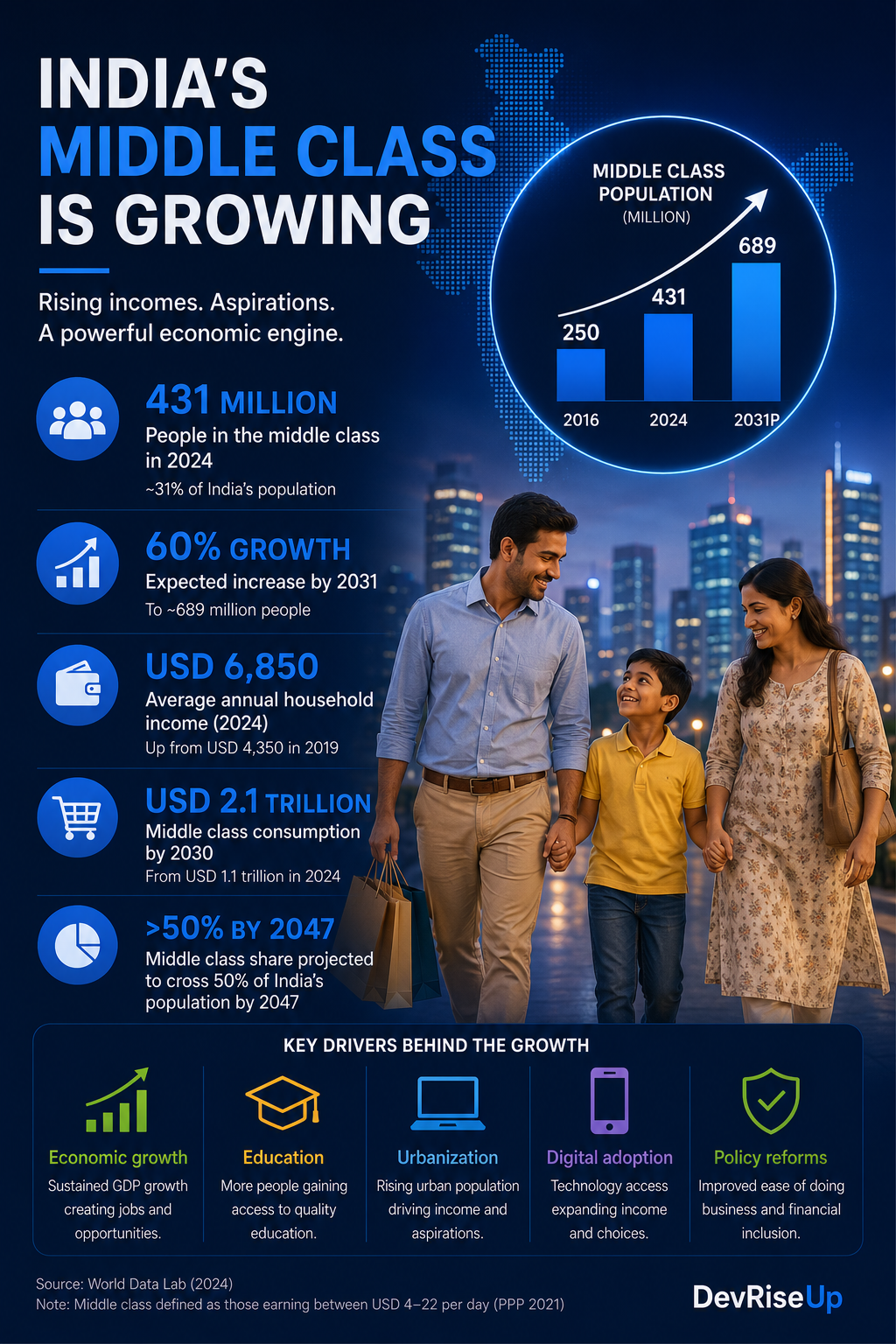
Figures relating to India are usually striking because of their sheer scale. With the middle class, however, it is different: here, it is the rate of growth that is striking.
In no other country in the world are so many people joining the middle class in such a short space of time as in India. This is changing markets, expectations and the rules of the game — including for European companies.
What ‘middle class’ means in India
The definition is not straightforward. The World Bank sets the threshold at a daily per capita income of between 12 and 50 US dollars (purchasing power parity). Indian economists often use an annual household income of between 5 and 30 lakh rupees as a benchmark — equivalent to around 5,500 to 33,000 euros.
According to this definition, between 300 and 400 million Indians currently belong to the middle class. This is roughly equivalent to the total population of the USA. Forecasts suggest that this group will grow to over 500 million by 2030.
What this group buys — and what that means
The Indian middle class is consuming differently than it used to. Smartphones are now the norm. Two-wheeled vehicles are being replaced by cars. The proportion of household expenditure spent on food is falling, whilst spending on education, healthcare and leisure is rising.
The Indian car market is now one of the three largest in the world. Demand for housing in the major cities has outstripped supply for years. E-commerce is growing — Flipkart and Amazon India are recording double-digit growth rates every year.
For companies in the DACH region with products in the premium segment, this means that India is no longer purely a low-price market. People are increasingly willing to pay for quality — particularly among the urban middle class aged between 30 and 50.
Regional concentration
The middle class is not evenly distributed. It is concentrated in the metropolitan areas: Delhi-NCR, Mumbai, Bengaluru, Chennai, Hyderabad, Pune and Ahmedabad. In these cities, disposable income is significantly above the national average.
Rural India, by contrast, has a significantly lower purchasing power. Around 65 per cent of the population still live in rural areas. The middle-class boom is an urban phenomenon — at least for the time being.
What India is still missing
Two factors are holding back the growth of the middle class. Firstly: the skills gap. The India Skills Report 2024 estimates that around 52 per cent of university graduates are employable. Many young Indians from low-income households are unable to climb the social ladder because their education does not meet the requirements of the labour market.
Secondly: the proportion of women in the labour force. India has one of the lowest female labour force participation rates in the world — around 22 per cent. This represents a significant untapped potential in economic terms.
Both factors act as a brake, but do not reverse the trend. The demographic fundamentals — 1.44 billion people, a median age of 28, and over a billion people of working age by 2050 — are structurally strong.
| Year | Middle Class (Mio.) | Share of Population | Annual Household Income (approx.) |
|---|---|---|---|
| 2005 | ~ 50 | ~ 4% | INR 5–30 Lakh |
| 2015 | ~ 150 | ~ 11% | INR 5–30 Lakh |
| 2024 | ~ 350 | ~ 24% | INR 5–30 Lakh |
| 2030 (forecast) | ~ 500+ | ~ 33% | INR 5–30 Lakh |
Sources: World Bank, PRICE India, McKinsey Global Institute — As at 2024
About the Author