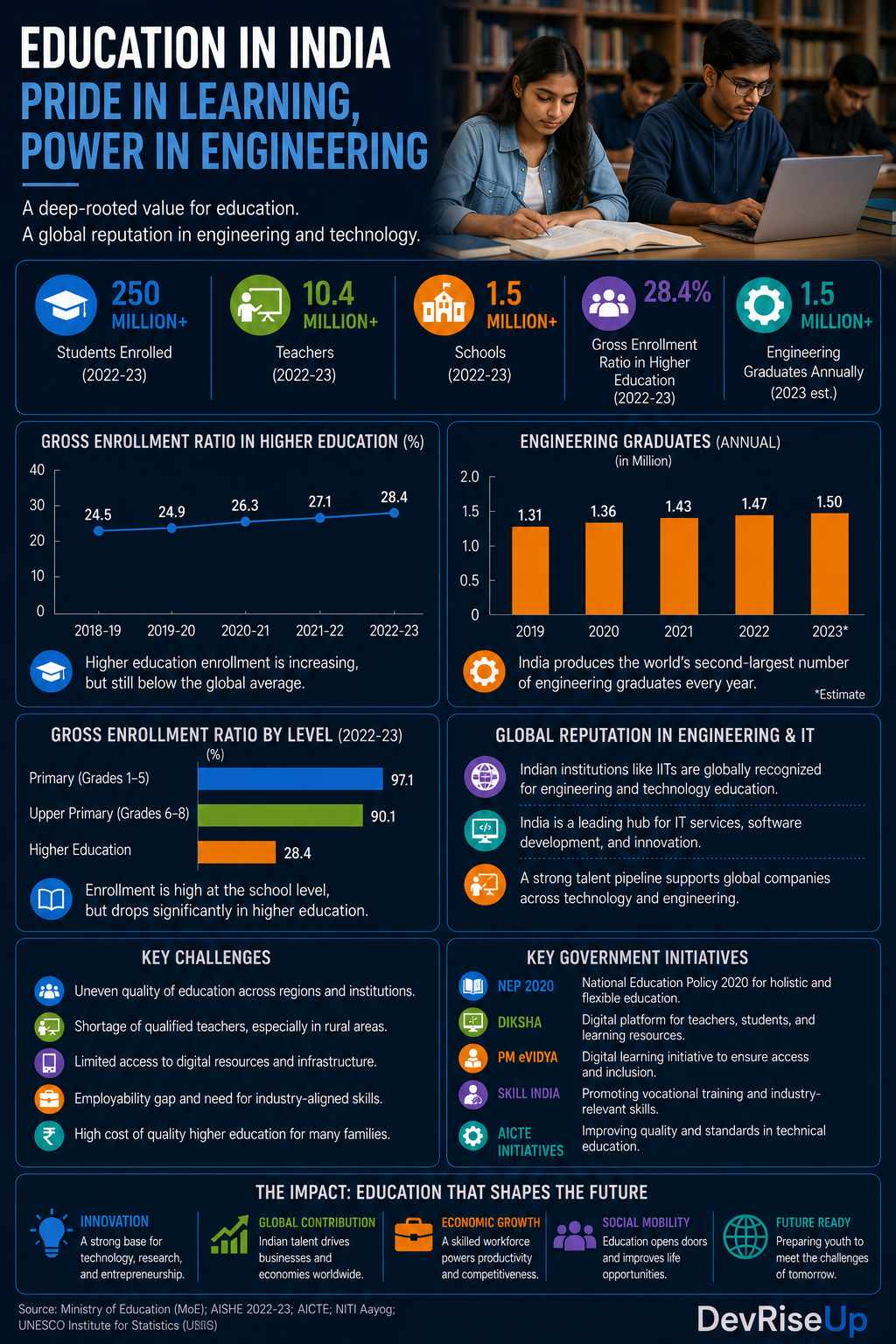
In Germany, engineer is a respected profession. In India, it is the ultimate goal for millions of families, regardless of talent, inclination, or market conditions.
This has consequences: for the labor market, for the quality of candidates, and for how Indian colleagues see themselves in international teams.
Advancement Through Education
India has no pronounced heritability of wealth in the Western sense. The classic path to advancement is: good school, good degree, good job. For the middle class and aspiring families, an engineering degree is the surest ticket in.
This explains why around 1.5 million students complete an engineering degree every year, more than in any other country in the world. It also explains why parents invest considerable sums in coaching centers. The city of Kota in Rajasthan is famous for its coaching industry: tens of thousands of students move there to prepare for the IIT entrance exam.
The IITs: A World-Renowned Elite
The Indian Institutes of Technology are the flagship of the Indian education system. There are currently 23 IITs; the first was founded in Kharagpur in 1951. The JEE Advanced entrance exam is considered one of the hardest in the world: around 1.2 million candidates apply each year for roughly 17,000 places.
IIT graduates can be found in the executive suites of global companies. Sundar Pichai (Google), Satya Nadella (Microsoft), and Indra Nooyi (PepsiCo) all went through Indian technology institutes. For recruiting managers in the DACH region, an IIT degree is a reliable quality signal.
The Gap Between Quantity and Quality
The problem lies not at the top but in the breadth. Alongside the IITs and the National Institutes of Technology (NITs), there are thousands of private engineering colleges whose degrees vary widely in quality.
The India Skills Report 2024 puts the share of employable engineering graduates at around 52 percent. HR managers who recruit regularly in India report that, realistically, only around 20 percent of incoming applications come from seriously qualified candidates.
This means that anyone recruiting in India needs a robust pre-screening process. A CV alone is not a reliable indicator.
Self-Perception in Working Life
Someone who grew up as an engineer in a society that equates education with social status brings a particular self-image with them. Indian IT professionals are often highly performance-oriented, ambitious, and sensitive to recognition.
This is a strength, provided it is put to use. Clear feedback on performance, visible career prospects, and the opportunity to work on challenging projects retain well-educated Indian colleagues more effectively than salary increases alone.
The opposite is equally true: someone placed in a team that works below their qualifications will quit, early and quietly.
| Institution | Number | Annual Graduates (approx.) | Entry Barrier |
|---|---|---|---|
| IITs | 23 | ~ 17,000 | JEE Advanced: extremely high |
| NITs | 31 | ~ 50,000 | JEE Main: high |
| IIITs | 25 | ~ 15,000 | JEE Main / own tests |
| Private Colleges | ~ 3,500 | ~ 1.4 Mio. | Highly variable |
Sources: AICTE, NIRF Ranking 2024, India Skills Report 2024
About the Author