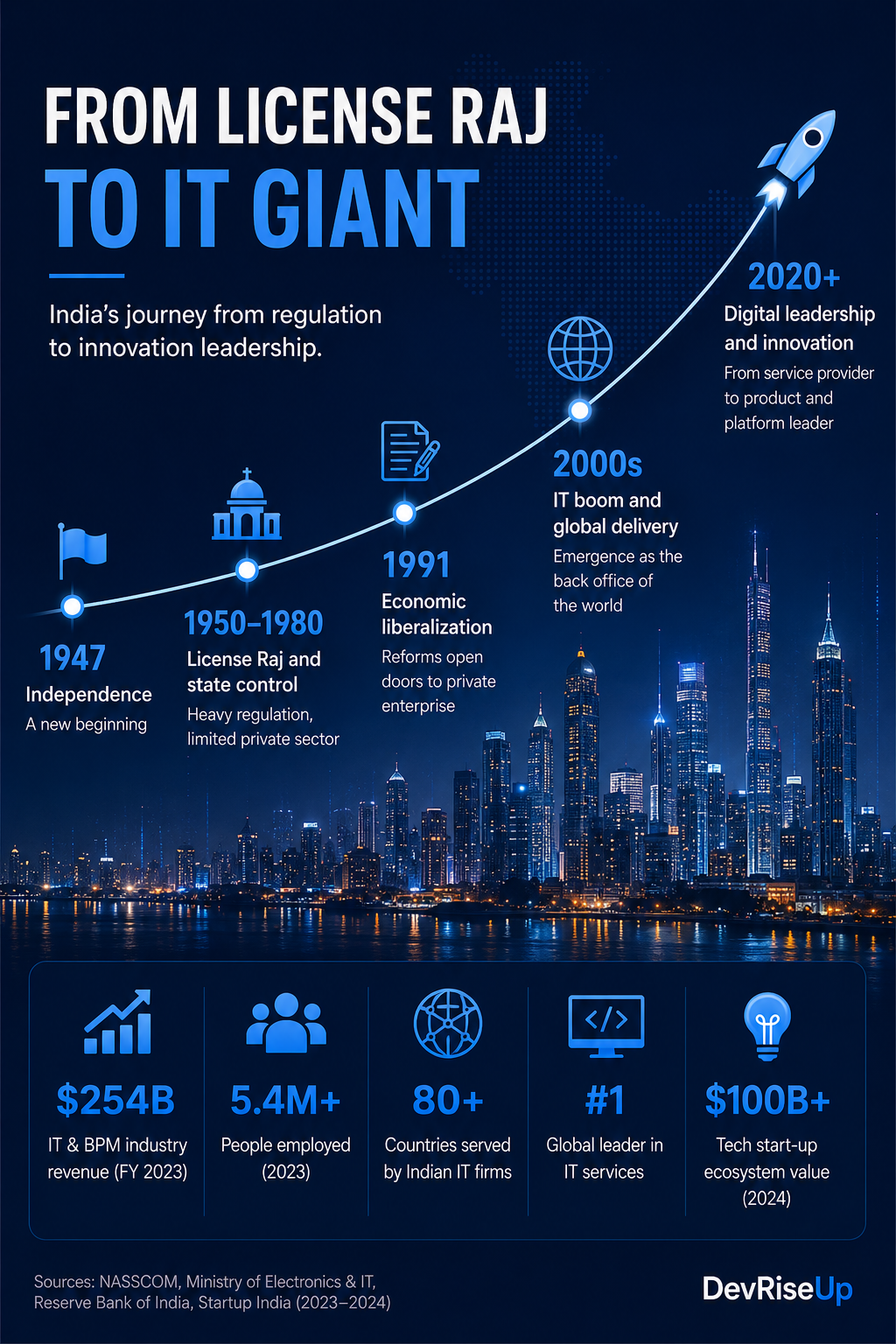
Anyone who wants to understand why India is now the world’s third-largest technology hub needs to look back to 1991. Before that, India was something quite different: a closed, sluggish planned economy — and had been for over four decades.
The licence jungle: India locks itself in
Following independence in 1947, India, under Jawaharlal Nehru, adopted the model of a state-directed economy. The result was the so-called ‘Licence Raj’ — a bureaucratic system that made virtually every economic activity subject to state authorisation.
Anyone wishing to build a factory, import a product or set up a business needed dozens of permits. In some states, the waiting time for a telephone line was several years. Foreign investment was largely prohibited. IBM and Coca-Cola left India in the 1970s because they were unwilling to accept local majority shareholdings.
The result: between 1950 and 1980, India’s economy grew by an average of around 3.5 per cent annually — barely more than the rate of population growth. Economists bitterly refer to this as the ‘Hindu rate of growth’.
1991: The forced opening
In the summer of 1991, India was on the brink of insolvency. Its foreign exchange reserves would only last a few weeks. The government secretly borrowed gold and flew it to London to secure loans.
Finance Minister Manmohan Singh used the crisis as a catalyst for reform. Within a few months, import barriers were lifted, licensing requirements were scrapped and foreign investment was permitted. This was no gradual reform — it was a radical overhaul.
The economy responded swiftly. Growth surged. And one sector benefited disproportionately: software.
Y2K: Der Zufallskatalysator
In the late 1990s, the world had a problem. Computers worldwide stored years as two-digit numbers. The turn of the millennium threatened to bring global IT systems to a standstill. Millions of lines of code had to be checked and corrected — quickly, cheaply, and in English.
Indian software companies rose to the challenge. Tata Consultancy Services, Infosys and Wipro built up capacity during this period, which they have not since scaled back. The Y2K programme was to India’s IT industry what the Marshall Plan was to Europe: a catalyst.
From the workbench to the innovation platform
The 2000s brought call centres and business process outsourcing. The 2010s: product companies, start-ups, proprietary platforms. In the 2020s, India is developing its own AI models and large language models for Indian languages.
The Indian IT sector generated revenue of around 254 billion US dollars in the 2024 financial year. It directly employs over five million people. This is no longer just an extension of the production line — it is a self-sustaining tech ecosystem.
For companies in the DACH region, this means that anyone working with Indian teams today is no longer simply working with low-cost resources. They are working with engineers who have been shaped by one of the world’s most innovative tech ecosystems.
| Year | Event | Economic Significance |
|---|---|---|
| 1947 | Independence | Beginning of the License Raj |
| 1984 | Rajiv Gandhi: Computerization | First IT impulses |
| 1991 | Economic Liberalization | Opening up to foreign investment |
| 1999/2000 | Y2K Program | Global reputation building for Indian IT |
| 2006 | Infosys NYSE Listing | Indian IT visible as a global player |
| 2024 | IT sector: USD 254 billion | Fifth-largest economy |
Sources: Ministry of Finance India, NASSCOM, Reserve Bank of India — as at 2024
About the Author