India is a secular state — that is enshrined in the Constitution. At the same time, religion is ever-present in everyday life: in the calendar, on our plates, in the office, and in the boardroom.
If you understand this, you’ll avoid putting your foot in it. If you ignore it, you risk more than just bad manners.
The six major religious communities
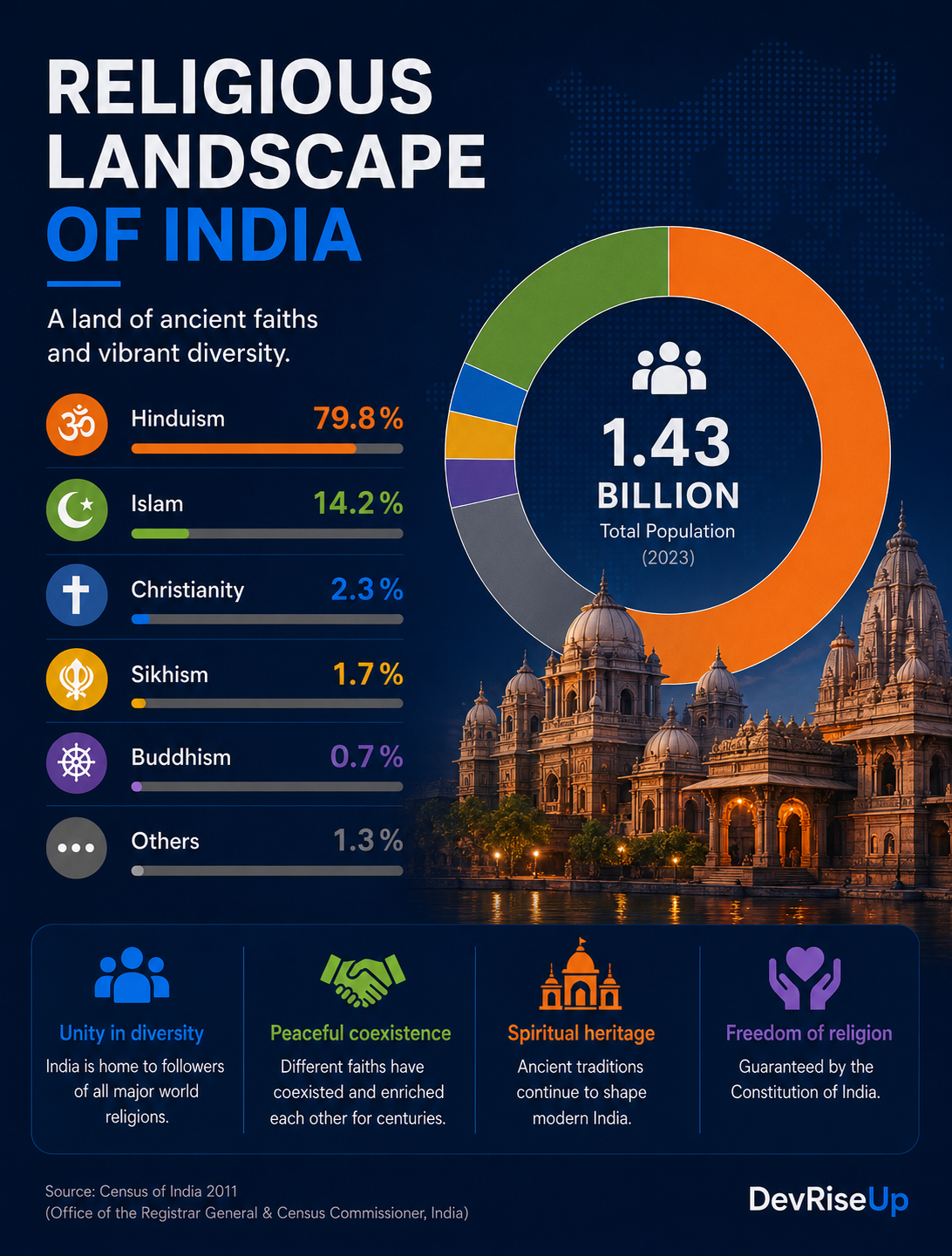
According to the 2011 census — the most recent survey available to date — around 79.8 per cent of the population identify as Hindu. Islam follows with 14.2 per cent. Christianity (2.3 per cent), Sikhism (1.7 per cent), Buddhism (0.7 per cent) and Jainism (0.4 per cent) make up the remainder.
These figures suggest that Hinduism is the dominant religion. In practice, however, this also means that, statistically speaking, every company with 100 employees has 14 Muslims, 2 Christians and perhaps one Sikh and one Jain on its team.
What this means for meetings and meals
The most common question about business etiquette concerns dining. Indian business meals are not a culinary minefield — provided you know a few basic rules.
Hindus do not eat beef. This applies particularly to Hindus belonging to the upper castes, but is widespread. Many Hindus are generally vegetarian, particularly in certain states (Gujarat, Rajasthan, Tamil Nadu). Muslims do not eat pork or drink alcohol. Jains are strictly vegetarian — they also avoid root vegetables such as onions and garlic, because harvesting them kills the plant.
Anyone organising a business lunch should choose a restaurant with a wide range of vegetarian options. ‘Pure veg’ means: no meat, no eggs, no alcoholic drinks. This isn’t a restriction, but a safe choice for mixed groups.
Public holidays: three tiers, little scope for planning
India has three national public holidays: Independence Day (15 August), Republic Day (26 January) and Gandhi Jayanti (2 October). In addition, depending on the state, there are between 8 and 14 further state public holidays — many of which are religious in nature.
What makes this special is that Hindu and Muslim holidays are based on the lunar calendar. Diwali, Holi, Eid and Gurpurab fall on different dates in the Gregorian calendar each year. Anyone planning important deadlines for early November without knowing the date of Diwali is not taking reality into account.
Recommendation: At the start of the year, draw up a joint public holiday calendar with the Indian team. Most Indian companies provide such calendars internally.
Religion in the workplace — what DACH executives need to know
Religion is rarely discussed openly in the Indian office, but it is a presence. An altar in the entrance area, a short prayer before a meeting, the desire for a moment’s quiet on a public holiday — these are all normal occurrences.
What is absolutely off-limits: jokes about religion, critical comments about Hindu practices, or any visible hierarchy based on religious affiliation. Questions about caste — which is closely linked to religion — should also not be asked in a professional context.
What goes down well: a brief, heartfelt “Happy Diwali” at the right time.
| Religion | Share of Population | Dietary Rules | Major Festivals |
|---|---|---|---|
| Hinduism | 79.8% | No beef; many vegetarian | Diwali, Holi, Navratri |
| Islam | 14.2% | No pork, no alcohol; Halal | Eid ul-Fitr, Eid ul-Adha |
| Christianity | 2.3% | No general restrictions | Christmas, Easter |
| Sikhism | 1.7% | No beef; no Halal meat | Gurpurab |
| Buddhism | 0.7% | Often vegetarian | Buddha Purnima |
| Jainism | 0.4% | Strictly vegetarian, no root vegetables | Paryushana |
Source: 2011 Indian Census, Ministry of Home Affairs
About the Author