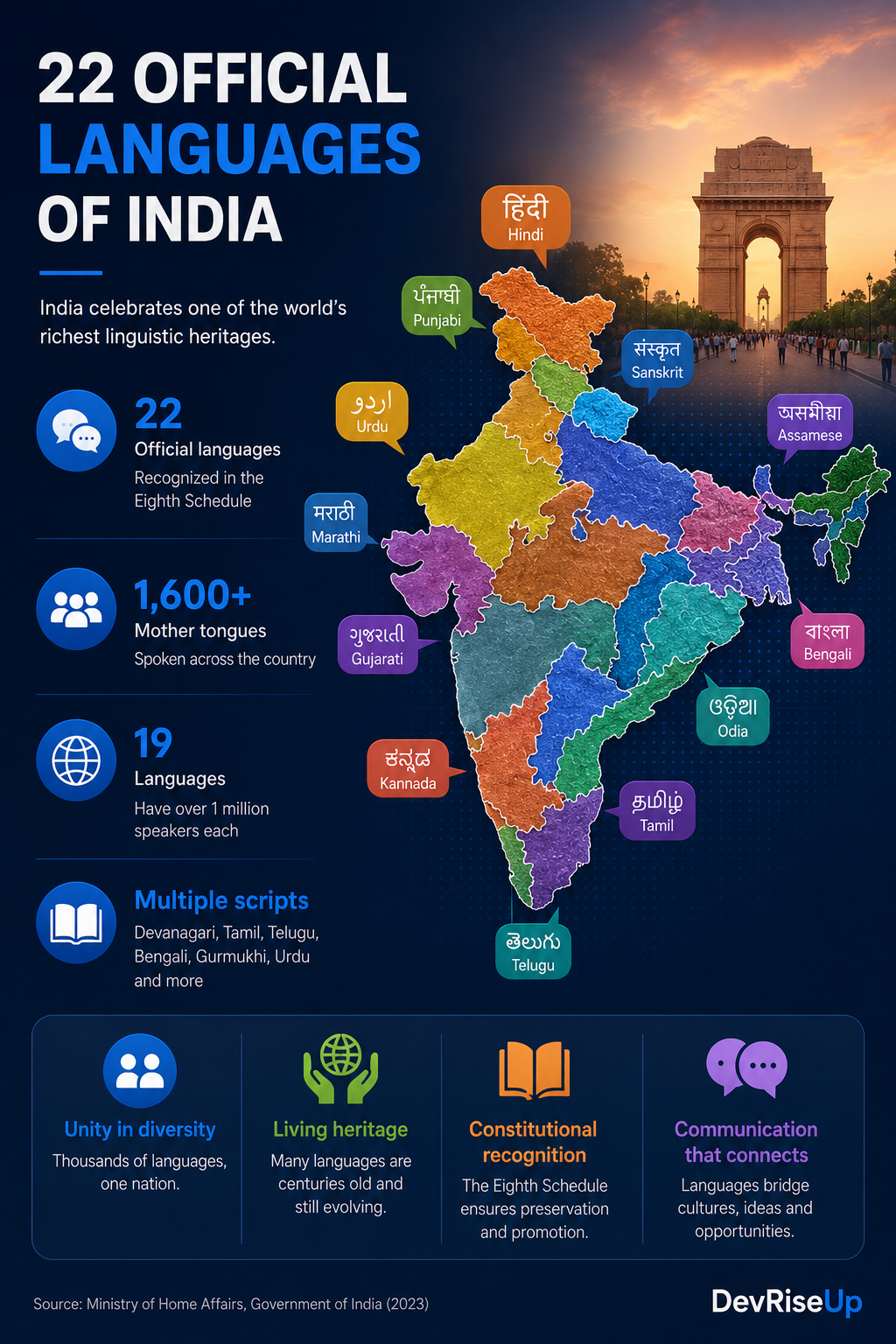
India does not have a single official language in the European sense. It has 22 of them.
The Eighth Schedule to the Indian Constitution lists 22 languages that enjoy official status. According to the 2011 census, there are a further 99 languages with more than 10,000 speakers. In total, around 121 languages are spoken in India.
Hindi is not a national language
This is one of the most persistent misconceptions. Hindi is spoken as a first language by around 44 per cent of the population — predominantly in northern India. In Tamil Nadu, Karnataka, West Bengal and Kerala, a significant proportion of the population does not understand Hindi. The central government’s attempt to establish Hindi as a universal official language has historically failed and remains a politically sensitive issue to this day.
Anyone communicating in English in South India will get much further than they would with Hindi. A South Indian who is addressed in Hindi during a conversation, even though they are fluent in English, may sometimes perceive this as an intrusion.
English as a lingua franca
English is effectively the lingua franca of Indian business life. It is a co-official language of the central government, the language of proceedings before the Supreme Court, and the language of instruction at all IITs, IIMs and most private universities.
In the IT sector, English is the sole working language. Project documentation, emails, meetings — everything is conducted in English. This represents a structural advantage for companies from the DACH region compared with collaborating with China or Japan.
Caveat: English is often spoken quickly, with a strong regional accent. Asking for clarification is not a sign of rudeness, but of professionalism.
The major regional languages and their significance
Alongside Hindi and English, four languages have a particularly strong influence on economic life.
Bengali is spoken by around 97 million people in West Bengal and is the cultural language of Kolkata and Bangladesh. Telugu dominates Andhra Pradesh and Telangana — and thus also the IT hub of Hyderabad. Marathi is the language of Mumbai and Maharashtra, one of the country’s largest economic regions. Tamil is one of the oldest living languages in the world, with a written tradition dating back more than 2,000 years, and is the defining language of Chennai and Tamil Nadu.
Anyone who works regularly in a city would do well to learn a few greetings in the regional language. This opens doors that English alone leaves closed.
Practical implications for cooperation
When it comes to day-to-day business communication, English is sufficient. But when it comes to building trust, regional awareness is key.
If you know that the majority of your team in Hyderabad speak Telugu, that Tamil is the emotional mother tongue in Chennai, and that a colleague from Mumbai speaks Marathi as their mother tongue — you will communicate with greater cultural awareness. This does not necessarily have to be reflected in language skills, but rather in respect for linguistic diversity.
One final point: Indian English speakers use certain phrases that sound unfamiliar to German-speaking ears. ‘Prepone a meeting’ (to bring forward, the opposite of ‘postpone’), ‘do the needful’ (to do what is necessary) or ‘out of station’ (travelling, unavailable) are perfectly acceptable business English in India.
| Language | Main Region | Speakers (approx.) | Economic Relevance |
|---|---|---|---|
| Hindi | Northern India | 600 million | Central government, consumer market |
| English | Pan-India | ~125 million (fluent) | IT, finance, law, higher education |
| Bengali | West Bengal | 97 million | Kolkata, industry, culture |
| Telugu | Andhra Pradesh, Telangana | 82 million | Hyderabad IT sector |
| Marathi | Maharashtra | 83 million | Mumbai, industry |
| Tamil | Tamil Nadu | 67 million | Chennai, automotive, IT |
Sources: 2011 Indian Census, Ministry of Home Affairs — as at 2024
About the Author