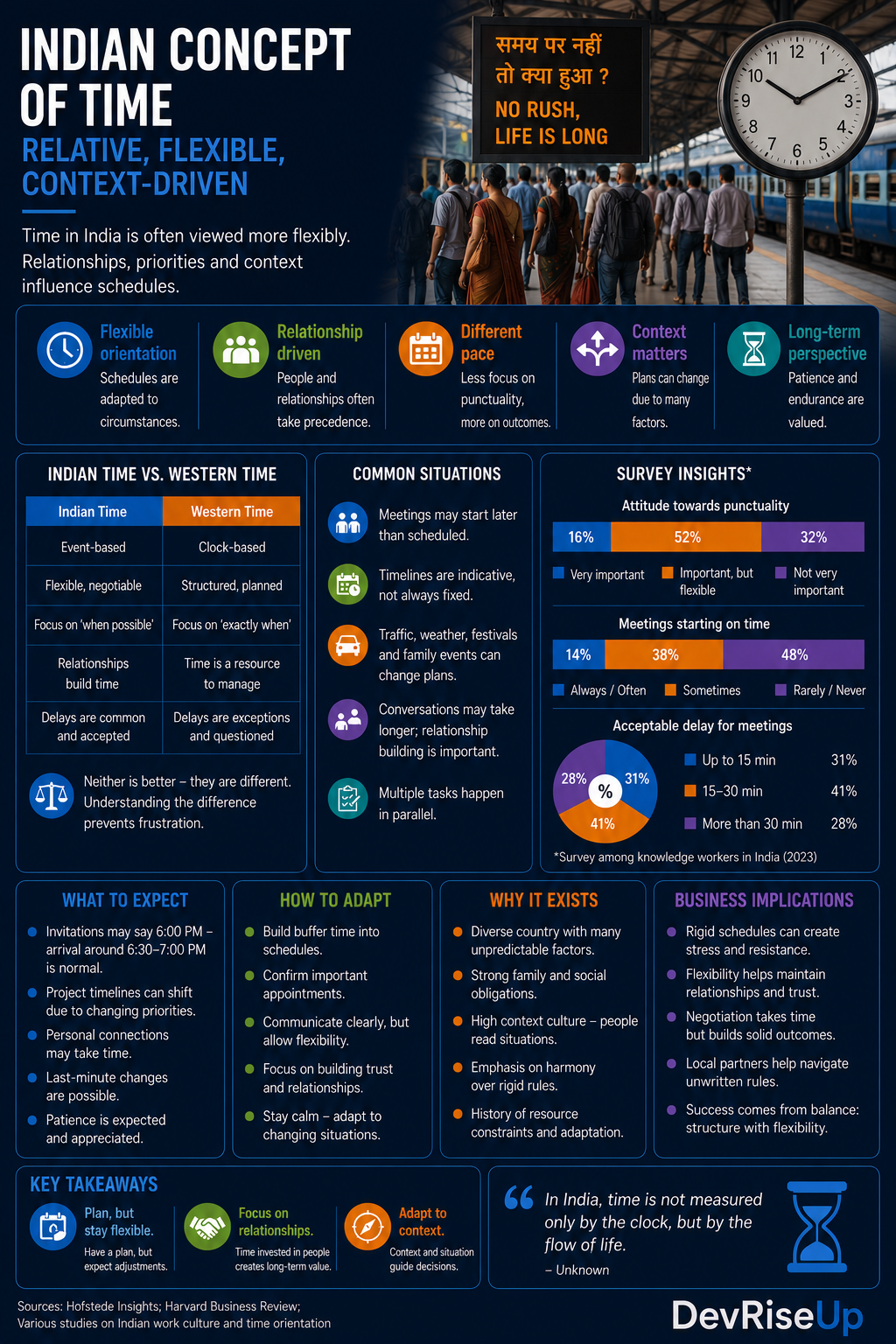
“IST” officially stands for Indian Standard Time, UTC+5:30. Unofficially, the abbreviation also circulates as “Indian Stretchable Time.” This is a cliché. It contains a kernel of truth.
Those who understand the Indian sense of time stop being frustrated and start planning better.
Polychronic Instead of Monochronic
Cultural research distinguishes between monochronic cultures, in which one thing is done after another, punctuality is seen as an expression of respect, and schedules are binding, and polychronic cultures, in which several things run at once, interruptions are normal, and relationships take precedence over schedules.
Germany is among the most strongly monochronic cultures in the world. India is polychronic. This is not a judgment; it is a structural description.
In polychronic cultures, “I’ll be right there” does not mean “in three minutes.” It means “the next thing I do is come to you, but other things may come up between now and my arrival.”
What This Looks Like in Practice
Meetings usually start 10 to 20 minutes after the scheduled time. This is not indifference; it is a social norm. Whoever is the only one to show up on time often ends up sitting alone in the room.
Deadlines are often interpreted as target values, not as contractual obligations. “We will try our best to deliver by Friday” means: Friday is possible, but not guaranteed. If you need it on Monday, name Friday as the deadline.
“I’ll call you back in five minutes” can mean 30 minutes, or the rest of the day. This is not a lie; it is a different relationship to the future.
Where Punctuality Counts
Blanket statements are of little help. Many internationally oriented Indian companies now apply considerably stricter time standards, especially in the IT industry. Teams that work daily with European or American counterparts are often more punctual than Indian government offices or family-run SMEs.
Formal occasions such as first business meetings, presentations to foreign clients, or entrance exams are generally attended on time. The leeway tends to show up in the day-to-day of ongoing collaboration.
Practical Recommendations
Four things help in collaboration:
Build in buffers. Setting internal deadlines two to three days before the external deadline gives you room for delays without having to explain yourself.
Confirm by phone. An email confirmation the day before does not protect against a no-show. A short call or a WhatsApp message on the morning of the appointment significantly reduces no-shows.
Don’t show impatience. Openly showing frustration over delays damages the relationship without changing the behavior.
Use clear wording. “Please by Thursday, 5 p.m. IST” is better than “preferably by the end of the week.”
| Situation | Expected Flexibility | Recommended Approach |
|---|---|---|
| Meeting start | 10–20 min. delay normal | Leave a buffer before the next appointment |
| Project deadline | Delay possible | Set internal deadline 2–3 days earlier |
| Callback / reply | Same day to next day | Follow up via WhatsApp or phone |
| First meeting (formal) | Usually on time | Prepare as usual |
| Day-to-day business | Variable | Regular short status check-ins |
Assessment based on common practice in German-Indian collaboration
About the Author