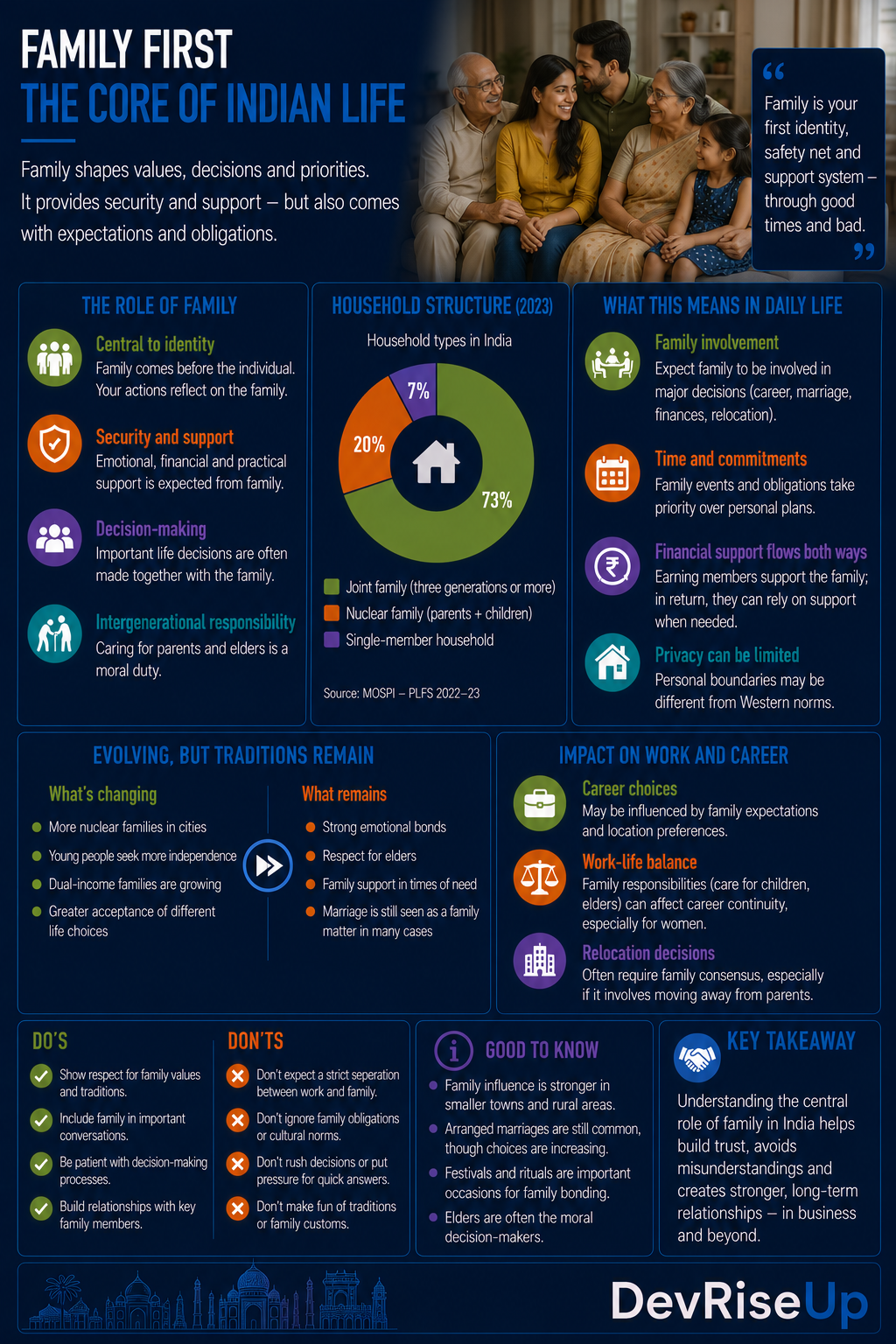
In Germany, most people separate professional and private matters fairly clearly. In India, this boundary is more permeable, and family matters often take precedence when weighing the two.
This is not a lack of professionalism. It is a different value system.
The Joint Family System
Traditionally, the extended family in India lives under one roof: parents, married sons with their wives and children, sometimes uncles and aunts as well. This model has come under pressure in urban environments, but it has by no means disappeared.
Even when an employee in Bengaluru lives in his own apartment, many of his life decisions are made in consultation with the family. Changing jobs, salary negotiations, moving to another city, taking on a leadership role: all of this is often discussed within the family. “I need to talk to my family” is not an excuse. It is honest.
Weddings: Not a Weekend Event
Indian weddings are not one-off celebrations. They are multi-day events with pre-wedding festivities, rituals, religious ceremonies, and post-wedding celebrations. Depending on the region, the ceremonies last three to seven days. On top of that, travel to other states or countries often takes several days.
For an employee whose brother or sister is getting married, this realistically means one to two weeks of absence. Add to that the weddings of cousins, close friends, and colleagues, in a social sphere where kinship networks are far more extensive than in German families.
Recommendation: Factor these absences into planning early and treat them as cultural normality, not as a disruption.
Festivals as Family Time
Diwali, Holi, Onam, Durga Puja: during these festivals, Indian professionals travel to their hometowns. This is not a preference. It is a social obligation. Tickets are booked months in advance. Scheduling meetings during these periods is technically possible, but not advisable.
The same applies to visits from parents. “My parents are visiting from [City X]” is a fully accepted reason not to be reachable in the evening or on the weekend.
Practical Consequences for Managers
Those who lead Indian teams build family time into their planning structurally. This means: annual planning at the beginning of the year, with known festival dates. Clear agreements on on-call availability. Understanding for family emergencies, which occur more often in India than in Western contexts.
What does not work: treating family matters as less legitimate than professional obligations. This creates frustration, not loyalty. Indian employees who feel they have to choose between the company and their family will, in the long run, choose their family.
What works well: asking the team early about planned absences and making time off possible without pressure to justify it.
| Occasion | Typical Duration of Absence | Predictability |
|---|---|---|
| Own wedding | 1–2 weeks | High (known months in advance) |
| Wedding of sibling / close relative | 1–2 weeks incl. travel | High |
| Diwali / Onam / Durga Puja | 3–7 days | High (date varies yearly) |
| Parents' visit / family emergency | 1–5 days | Low (short notice) |
| Household ritual (e.g., Gruhapravesh) | 1–2 days | Medium |
Assessment based on common HR practice in Indian IT companies
About the Author