Anyone talking about India first needs the right sense of scale.
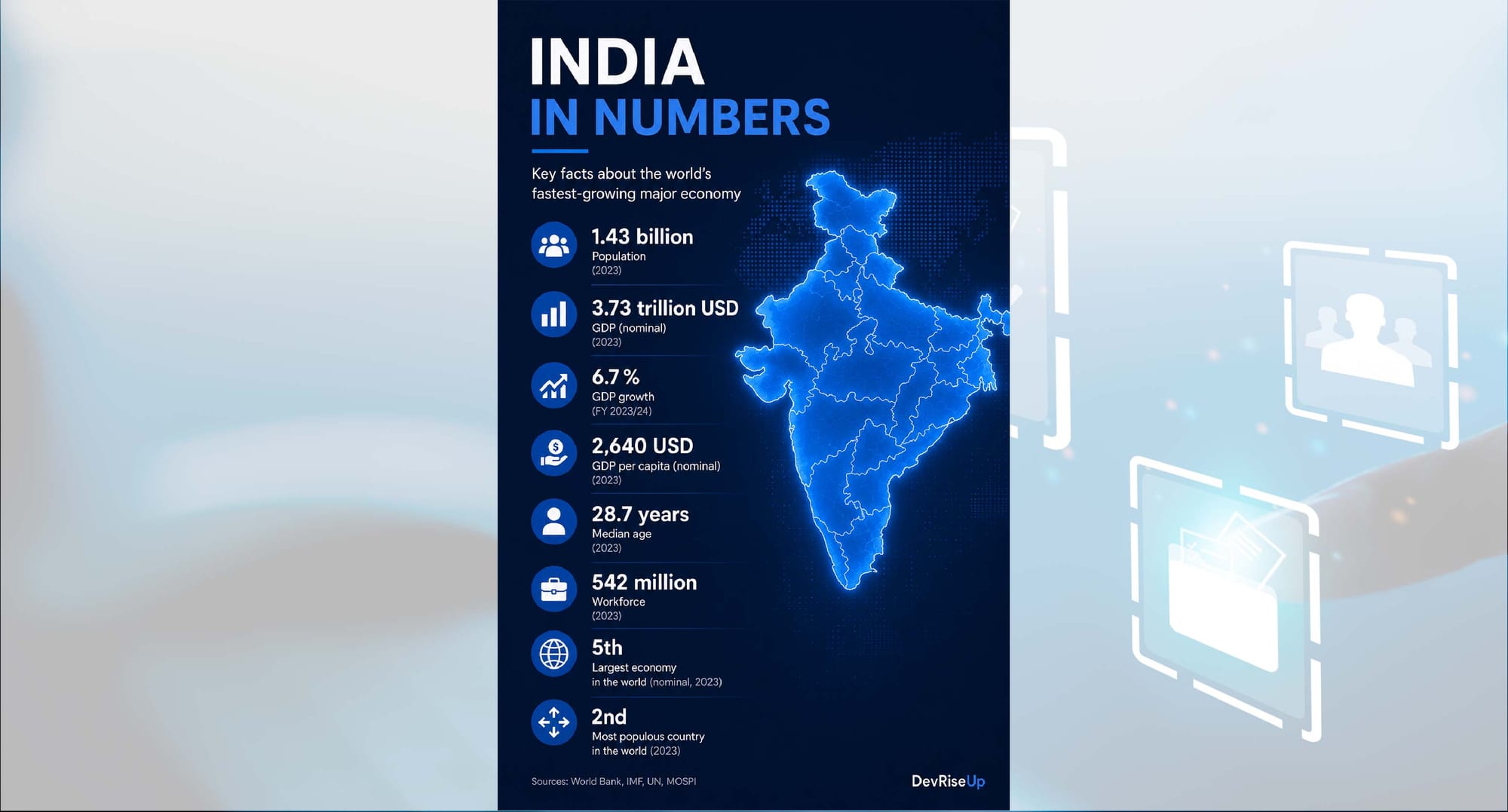
Since April 2023, India has been the most populous country in the world, with 1.44 billion people - nearly 17% of the global population. For the first time in decades, China is no longer number one.
The youngest workforce in the world
India’s median age is just 28.
In Germany, it is 46. In Japan, 49.
Nearly two-thirds of Indians are younger than 35, giving India the world’s largest pool of young working professionals and that pool is still growing.
Every year, around 1.5 million students graduate with an engineering degree in India. Germany produces roughly 90,000 engineering graduates during the same period.
This difference explains why global technology companies have systematically looked toward India since the 1990s.
At the same time, quality varies significantly:
India’s IITs - the Indian Institutes of Technology - rank among the world’s leading technical universities. Alongside them, however, there are thousands of regional colleges with widely differing educational standards. Companies recruiting in India should understand this distinction.
The fifth-largest economy
India’s GDP surpassed the United Kingdom’s in 2022. Since then, India has ranked among the five largest economies in the world.
Annual economic growth has remained consistently above 6%, while Germany has seen little to no growth over the same period.
The IMF expects India to move into third place globally by 2030 - ahead of Japan and Germany.
Much of this rise has been driven by software and services.
Bengaluru as a benchmark
Bengaluru represents this transformation better than almost any other city.
In fiscal year 2024, India’s IT sector generated approximately USD 254 billion in revenue and directly employed more than five million people.
Bengaluru alone hosts development centers for companies such as Google, Microsoft, SAP, Bosch, and Siemens.
Anyone visiting Bengaluru in 2005 would still have seen open fields on the outskirts of the city. Today, those same areas are filled with office complexes comparable to those in Frankfurt or Munich.
What this means for 2030
Two major trends are unfolding in parallel:
India’s middle class is expanding rapidly. Estimates suggest that by 2030, more than 500 million Indians will belong to the middle class. As a consumer market, that is equivalent to more than six times the population of Germany.
At the same time, Europe is aging. Germany is losing qualified professionals faster than its education system can replace them. The gap continues to widen.
Both developments point in the same direction: India is becoming increasingly important for Europe - economically and strategically.
Companies planning for the long term can no longer afford to ignore India.
India vs. Germany - key figures
| Metric | India | Germany |
|---|---|---|
| Population | 1.44 bn | 84 m |
| Median age | 28 years | 46 years |
| GDP ranking (2024) | #5 | #3 |
| Annual GDP growth | ~7% | ~0% |
| Engineering graduates per year | 1.5 m | ~90,000 |
| IT sector revenue (FY 2024) | USD 254 bn | — |
Sources: UN, IMF, NASSCOM, Destatis (2024)
About the Author