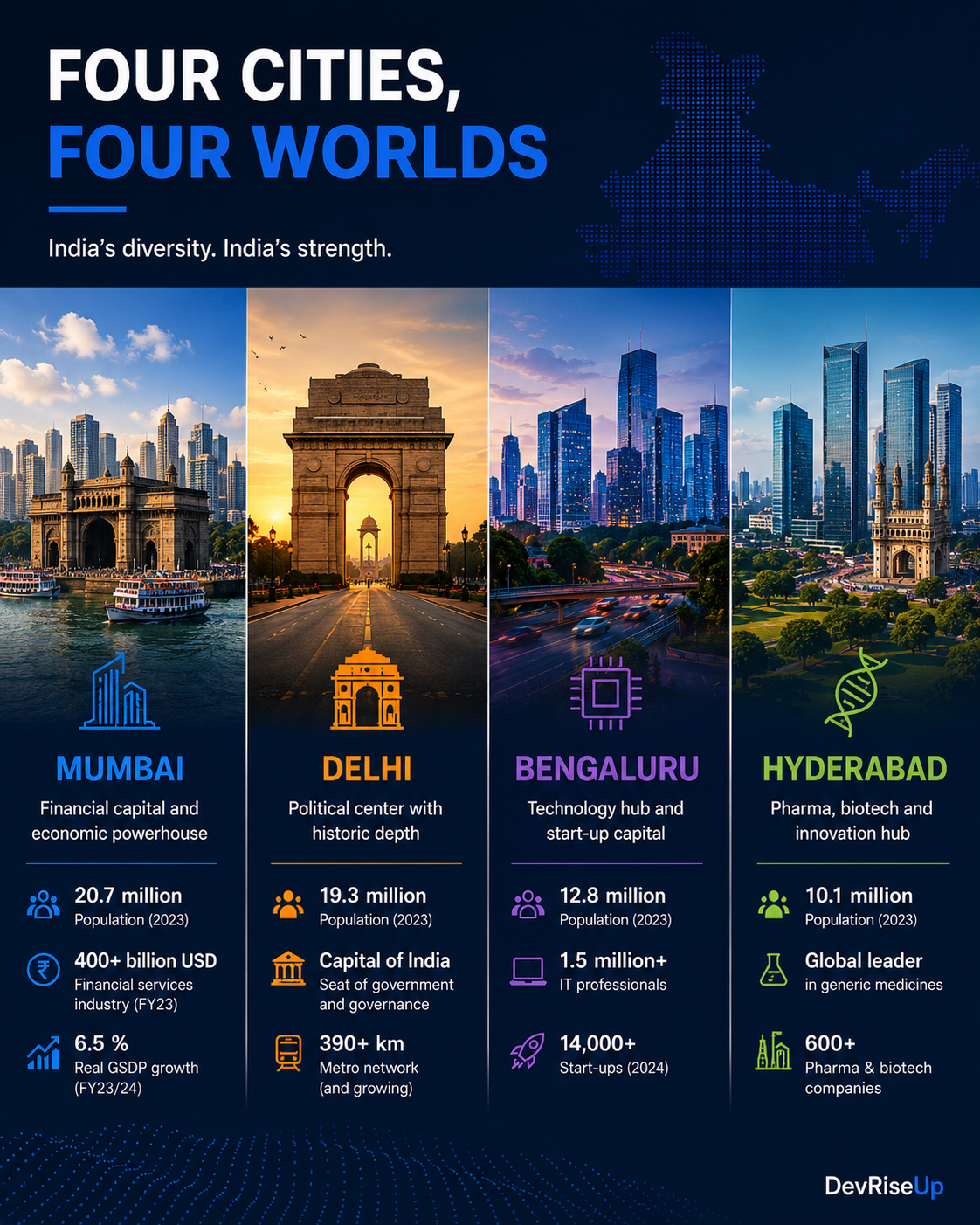
India is not a homogeneous market. Anyone working with Indian companies will encounter very different business cultures — depending on which city the meeting takes place in.
Bengaluru — IT and software
Bengaluru is India’s technology hub. It is home to the development centres of Google, Microsoft, SAP, Infosys and Wipro, amongst others. The districts of Whitefield and Electronic City are home to hundreds of international companies.
Anyone looking to build development teams, forge software partnerships or recruit tech talent should start in Bengaluru. Key contacts include CTOs, engineering managers and start-up founders. English is the working language. The climate is the most pleasant in India — the city lies at an altitude of around 900 metres.
The price to pay for this location: according to the TomTom Traffic Index 2025, Bengaluru ranks second among the world’s most congested cities. A two-kilometre journey can take 30 minutes. Allowing extra time between appointments is not just a recommendation, but a necessity.
Mumbai — Finance and Trade
Mumbai is India’s financial hub. It is home to the Bombay Stock Exchange, the National Stock Exchange and the headquarters of India’s largest banks and insurance companies. Anyone wishing to meet investors, raise capital or negotiate trade partnerships comes to Mumbai.
The Bandra Kurla Complex (BKC) financial district matches European standards in terms of density and rent prices. The climate is hot and humid. The monsoon months from June to September regularly bring flooding.
Mumbai is also India’s media hub. Anyone wishing to gain a foothold in the Indian market will, sooner or later, need a connection in this city.
Delhi / NCR — Politics and Administration
The Delhi-NCR (National Capital Region) is the centre of government decision-making. Federal ministries, embassies and regulatory authorities are based here. Anyone requiring licences, seeking public contracts or wishing to negotiate regulatory frameworks conducts their discussions in Delhi.
The NCR also includes Gurugram (formerly Gurgaon) and Noida — cities with a growing IT and services infrastructure. Many multinational corporations maintain their Indian headquarters there to take advantage of their proximity to government bodies.
The climate is extreme: summers reaching 45 degrees Celsius, winters with frost, and air quality regularly falling below critical thresholds.
Chennai — Industry and Manufacturing
Chennai is regarded as India’s automotive hub. BMW, Hyundai and Renault-Nissan have production facilities here. Added to this are a growing IT sector and one of southern India’s most important ports.
Anyone looking to establish manufacturing partnerships or build supply chains will find production managers, supply chain experts and engineers in Chennai with whom to discuss these matters.
Culturally, Chennai has a more distinct identity than Bengaluru or Mumbai. The regional language is Tamil, not Hindi. English is widely used in business.
Hyderabad und Pune — the next row
Two cities are worth mentioning. Hyderabad is India’s fastest-growing IT hub — Google has established its largest site outside the US there. Pune is emerging as the second most important automotive city after Chennai and has a growing IT presence.
Anyone who finds Bengaluru too expensive or too congested will find solid alternatives in Hyderabad and Pune
| City | Focus | Contacts | Climate |
|---|---|---|---|
| Bengaluru | IT, Software | CTOs, Dev Teams | Pleasant (900 m) |
| Mumbai | Finance, Trade | Investors, Bankers | Hot, humid |
| Delhi / NCR | Politics, Administration | Ministries, Embassies | Extreme |
| Chennai | Industry, Automotive | Production, Engineers | Very hot |
Sources: TomTom Traffic Index 2025, NASSCOM, Invest India — as at 2024/2025
About the Author