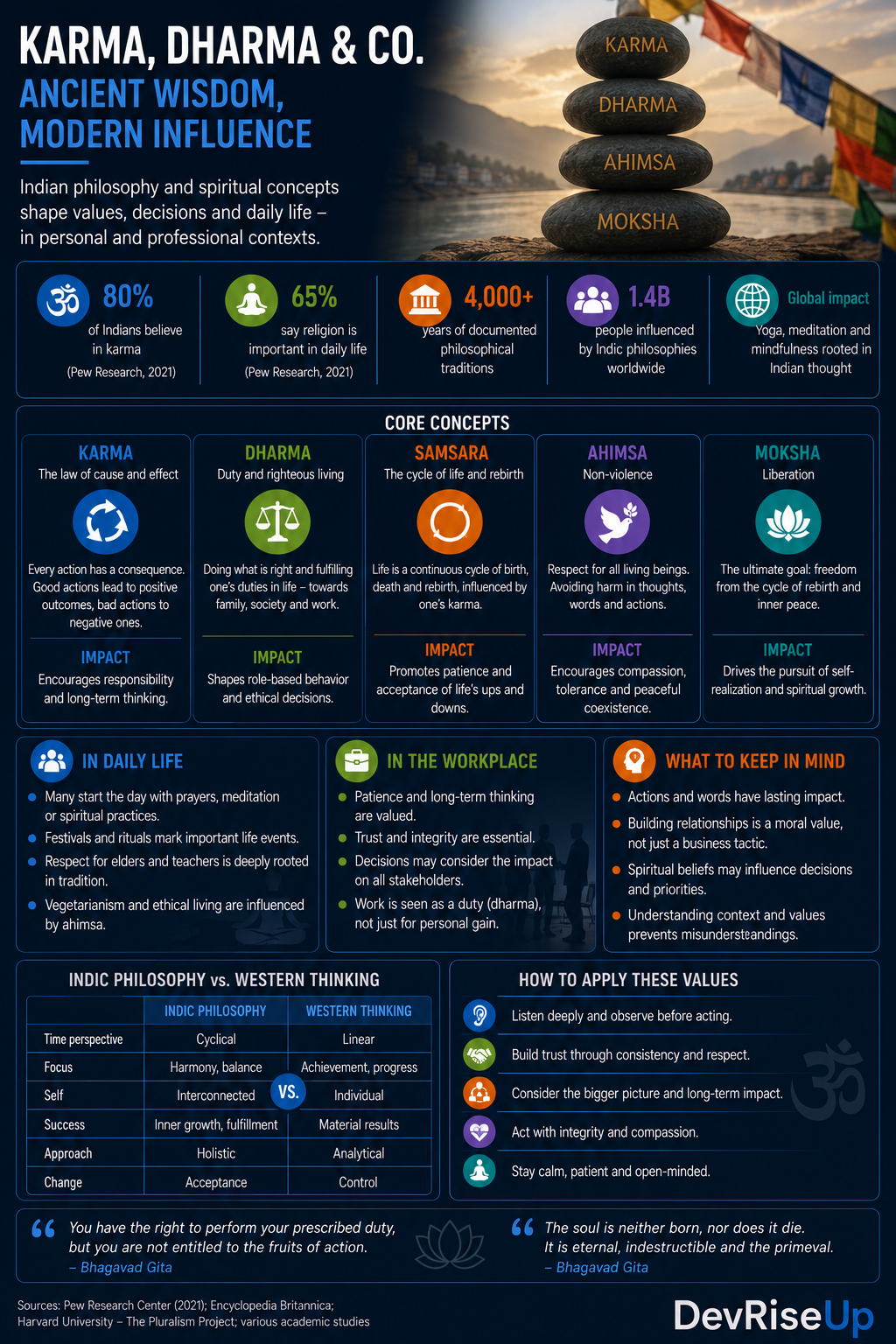
Hindu concepts are not folklore. They are a system of thought that unconsciously structures the actions of many Indians, including secular, Western-educated professionals.
You do not have to share it to understand it. And understanding helps.
Karma: Not Fate, but Causality
In Sanskrit, karma literally means "action." The concept describes how every action has consequences, in this life and in future ones. This is not passive resignation to fate. It is a causal view of the world: those who act well create good consequences.
In everyday business, karmic thinking sometimes shows up as a striking patience in difficult situations. What looks like passivity from a German perspective may be a conscious stance for the other person: the situation will not be improved by impatience, and acting when the moment allows is better than forced activity.
Dharma: Duty Before Preference
Dharma describes the right way to act according to one's own role. What is right for a doctor is different for a merchant. What is right for a son is different for a superior.
In working life, dharmic thinking expresses itself in a strong sense of duty toward hierarchy and role. A young employee who does not publicly contradict his superior is not acting out of cowardice. He is acting according to dharma: it is not his role to undermine the superior's authority.
This explains why Indian colleagues sometimes carry out tasks they consider of little use without objecting. For many, objecting would amount to a breach of the structure of roles.
Muhurta: The Right Moment
In astrology, muhurta is an auspicious period of time for important decisions. For contract signings, business openings, or building a house, many Indians consult an astrologer or follow the lunar calendar.
In an international company, this is rarely communicated openly. But a contract that "still needs to be reviewed," or a meeting that is postponed shortly before conclusion, sometimes has no logistical reasons. Those who know this interpret the situation differently and respond more patiently.
Artha: Prosperity as a Legitimate Goal
A widespread misunderstanding sees Hinduism as otherworldly and indifferent to material things. That is wrong. Artha, meaning prosperity and material success, is one of the four goals of life in the Hindu system. It is legitimate and worth striving for, as long as it is acquired ethically.
This explains the pronounced orientation toward performance and success that many Indian professionals bring with them. Career advancement does not contradict spiritual self-understanding. It is part of it.
Dealing with It in Everyday Life
Nobody expects DACH managers to study Hinduism. What is expected is respect: no jokes about religious practices, no attempts to correct astrological beliefs, no impatience when a colleague wants to "review a decision once more in peace."
Anyone who encounters an altar at the office entrance, experiences a short prayer break before a meeting, or receives an invitation to a religious festival is meeting a value system that has sustained billions of people over millennia. Curiosity and respect get you further than distance.
| Concept | Meaning | Possible Impact in Everyday Business |
|---|---|---|
| Karma | Actions have consequences | Patience with problems, expectation of fairness |
| Dharma | Duty according to role | Respect for hierarchy, no open objections |
| Muhurta | Auspicious timing | Postponement of contract signings |
| Artha | Legitimate prosperity | Orientation toward performance and advancement |
| Ahimsa | Non-violence | Conflict avoidance, indirect communication |
About the Author