Why many projects are technically complete but practically unusable
Development is underway. Sprints are being completed, features are being created, code is being written. But there is often a huge gap between "technically functional" and "productively usable". Untested code, missing documentation, unclarified usage rights – these gaps cost companies more than the entire development after the project is completed.
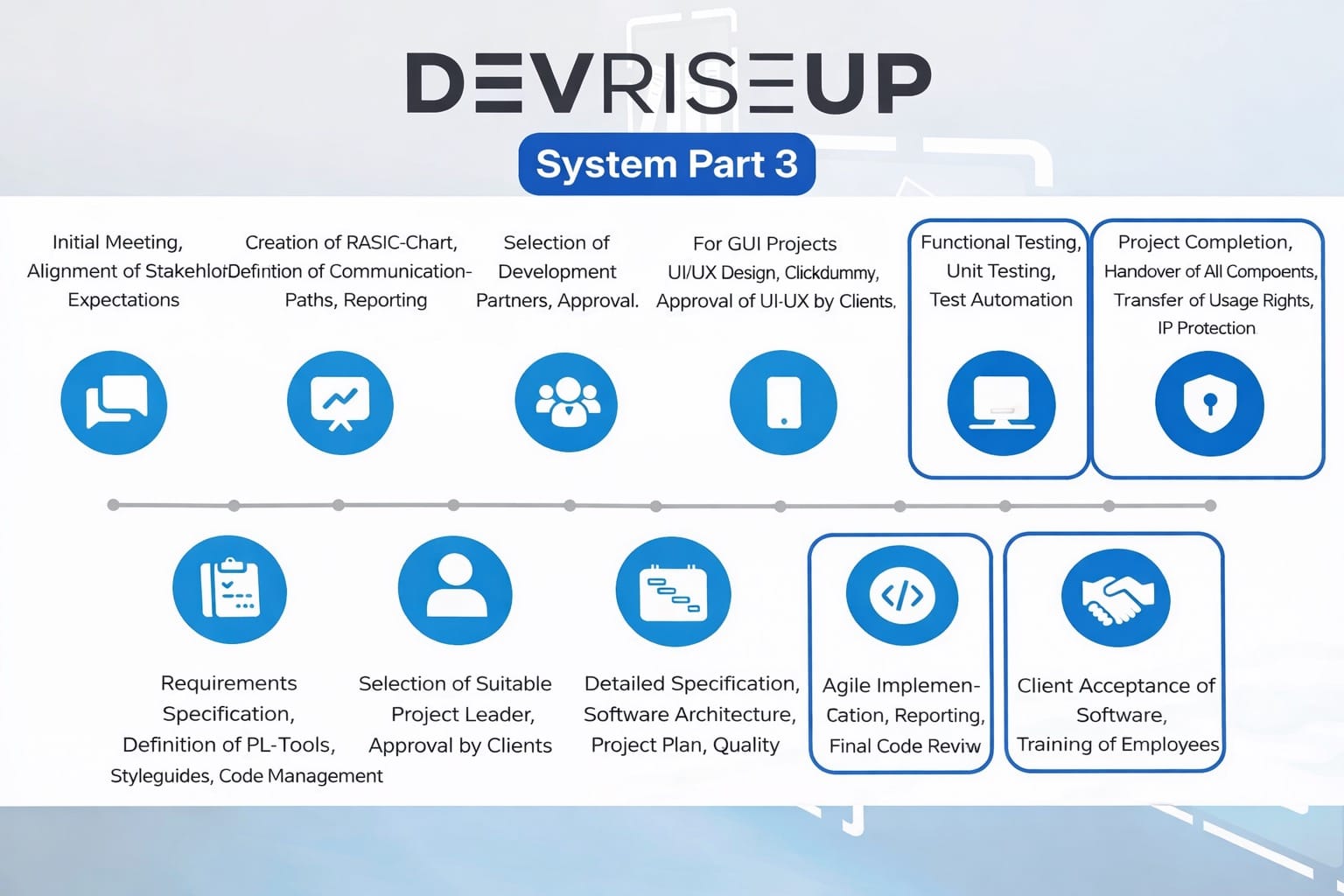
In the third and final part of our series, we show how the DevRiseUp system ensures that you end up with not just software, but a production-ready system with everything you need to operate it.
Step 1: Agile development with customised reporting
At DevRiseUp, agile development does not mean "chaotically flexible", but rather structured adaptability. We work in sprints, but we tailor our reporting entirely to your needs:
- Time-based: Daily stand-ups, weekly status calls, monthly reviews
- Progress-based: Reporting after completion of defined features or user stories
- Quality gate-based: Detailed reports upon passing each quality gate
You determine the frequency, level of detail and format. Some customers want detailed burndown charts and velocity tracking. Others prefer compact executive summaries. Both are possible – and everything in between.
Transparency is not just a buzzword for us, but a practice we live by. You know where your project stands at all times.
Independent code review: the objective view
This is where we differ from many of our competitors: at the end of development, an independent testing centre certified according to ISO/IEC 20246:2017 carries out a code review. This standard defines the international standard for work product reviews in software and system development.
Why this independence?
For you as a customer: you receive objective certainty about code quality, security and maintainability – not just our word, but proof from a third party in accordance with international standards.
For us: we provide documented proof that we have delivered quality. No discussions, no grey areas – just verified facts in accordance with ISO/IEC 20246:2017.
The independent code review checks for security vulnerabilities, code quality, compliance with best practices and potential maintenance issues. You receive a detailed report with recommendations for action.
Step 2: Functional testing, unit testing, test automation
Testing is not an option, but a requirement. The development partner carries out comprehensive testing:
Functional testing checks whether the software does what it is supposed to do – from the user's point of view. Each user story is tested against its acceptance criteria.
Unit testing validates individual code components in isolation. Good unit test coverage prevents regressions and makes subsequent changes much easier.
Test automation saves time and money in the long term. Automated tests run with every build, catch errors early and enable continuous integration.
Do you have your own testing infrastructure or would you like to set one up? We support you in this so that you can test yourself in the long term.
Step 3: Customer acceptance and training
The software has been developed, tested and checked. Now it's time for formal customer acceptance. This moment is based on the quality gates and the definition of done that we defined at the beginning.
You don't check at random, but against clear, pre-agreed criteria. Each function is validated against the specification. Only when everything fits is acceptance granted.
At the same time, we create comprehensive documentation: technical documentation for developers and operations, user documentation for end users, and administration manuals for IT operations.
Training: Passing on knowledge
Software without trained users is worthless. DevRiseUp trains your employees in every format:
- End-user training: So that your employees can use the software productively
- Admin training: So that your IT department can operate, maintain and configure the software
- Developer training: If your team wants to further develop the software
Format? Video tutorials, live sessions, train-the-trainer, workshop series – you choose.
Step 4: Project completion and full handover
At the end, all project components are handed over in full:
- Source code: The complete source code in your repository
- Documentation: Technical, specialist, operational – everything is handed over
- Access and credentials: All necessary access for operation and maintenance
- Transfer of usage rights: Clear, legally compliant transfer of all IP rights
The last point is critical: you have paid, you have had the development done, the work done belongs to you, not to third parties. DevRiseUp ensures that all usage rights are transferred and your intellectual property is protected in a legally compliant manner.
Service Level Agreements: Even after the project is complete
Many customers do not have the capacity for maintenance and further development. That is why we offer SLAs on request: from simple troubleshooting to regular updates and continuous further development.
Flexible contract models allow you to focus on your business while we maintain your software and keep it up to date.
The DevRiseUp system: The difference
From the initial stakeholder analysis to the final handover: The DevRiseUp system ensures that outsourcing projects do not fail. Through German project management, systematic preparation, clear quality gates and independent quality testing.
The result: software that works, is documented, can be used by your employees and is legally yours.
Ready for your next outsourcing project? Contact us for a free initial consultation. We will show you how the DevRiseUp system can also lead your project to success.
About the Author