Why even the best planning fails if implementation preparation is lacking
The foundation from the first part is now in place. Stakeholders have been consulted, specifications have been drawn up, and communication channels have been defined. But this is precisely where 30 to 50 per cent of all outsourcing projects fail: in the transition from theory to practice. According to legal experts, neglecting this bridge phase is one of the main reasons for project failure.
In the second part of our series, we show how the DevRiseUp system closes this gap: through systematic partner selection, precise specifications and clear acceptance criteria.
The challenge: from concept to code
Specifications describe the "what", not the "how" . This transformation is the critical moment: unclear software architecture, lack of a "definition of done" in the individual project phases, lack of coordination – every gap costs months and blows budgets.
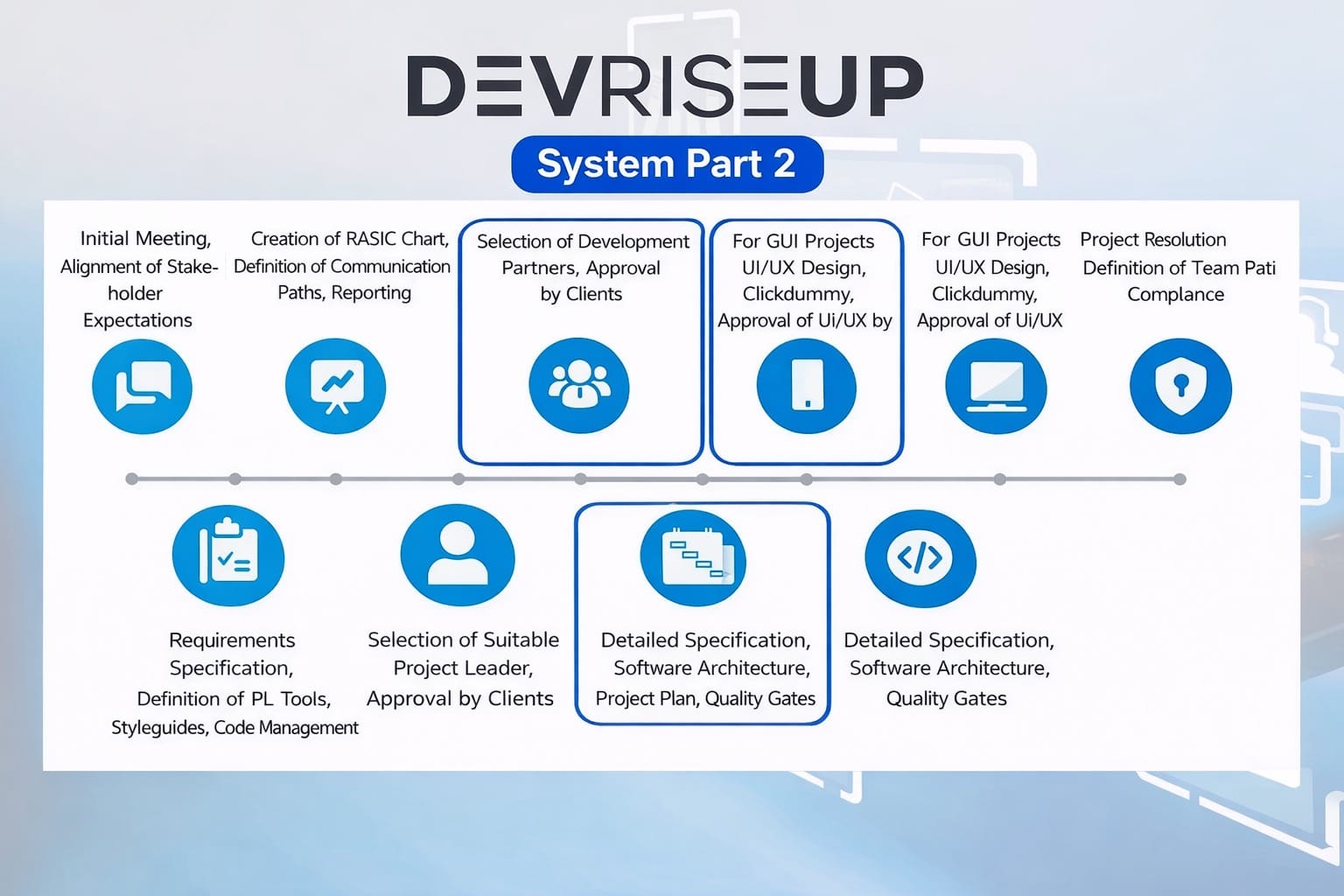
Step 1: Finding the right development partner
DevRiseUp works with several development partners in India – strategic diversity, because every project has different requirements.
Our selection criteria:
- Project size: A two-person team of specialists or a 15-person platform development team? We select partners with the appropriate capacity.
- Certifications: TISAX for automotive? ISO 13485 for medical technology? We match partners with the necessary compliance certificates.
- Know-how: React Native, Flutter, native development, legacy migration or cloud-native – each partner has specific strengths.
- Track record: We check for proven success in comparable projects.
The decisive difference: you approve the partner. The human component must be right. Our partners present themselves, you ask questions, we create transparency.
Step 2: Specifications, user stories and software architecture
The development partner creates the specifications and user stories based on the requirements specification. This step is time-consuming – but immensely important.
The specifications describe the "how" of implementation. User stories translate business requirements into developable units. The software architecture defines the technical foundation.
Critical: Your product owner checks every detail. This review process ensures that the right software is created – no interpretations, no nasty surprises. Your product owner is relieved, but remains in the loop and receives all technical details in a structured format for approval. We do the work!
The software architecture is agreed upon jointly: How do components communicate? Which technology stacks? How does the system scale? We clarify these questions before development.
Step 3: Realistic project plan
We create a project plan that realistically reflects complexity – with milestones, dependencies and buffers. No unrealistic deadlines, just honest assessments based on experience.
Step 4: Quality gates – the definition of done
Quality gates are predefined acceptance criteria that must be met before the next phase begins. They function as an early warning system.
Unlike time-based milestones – which are often "overrun" – quality gates are quality-based. The next gate is only passed when all criteria have been met. No "90 per cent syndrome", no self-deception.
The Definition of Done clarifies: When is a function truly complete? All parties involved have the same understanding – this common language prevents misunderstandings in international projects.
Quality gates minimise rework costs, create transparency and are the difference between controlled development and chaotic hope.
Step 5: UI/UX design (if relevant)
For projects with a strong user interface, we create a UI/UX design concept including a click dummy. DevRiseUp has specialists for user studies, wireframes and interactive prototypes. A tested click dummy identifies usability problems early on – not after months of development.
Step 6: Development approval
Only now do you give the development approval. This moment is your conscious starting signal: you know who is developing what and how. You know the acceptance criteria.
This structured preparation is your project's life insurance. The alternative? Start development and hope for the best – this hope costs companies millions.
What's next?
In the third and final part, we show how the DevRiseUp system works in the development and completion phase – from the first sprint to the final handover.
Ready to set up your outsourcing project professionally? Feel free to contact us for a free initial consultation.
About the Author